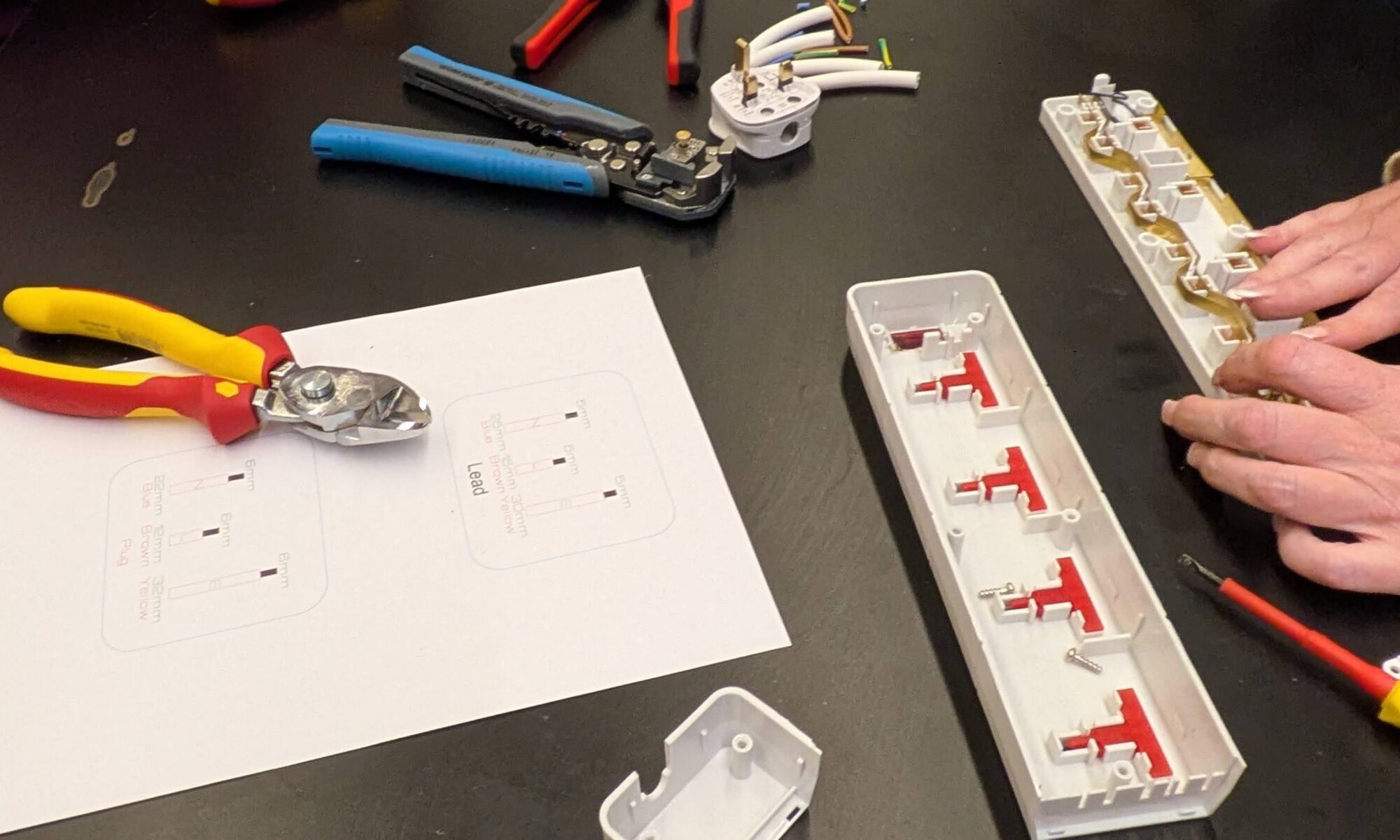
We’re running our Learn to Wire a Plug workshop again at TOG Hackerspace — a practical, confidence-boosting skill that’ll serve you for years. If you’ve ever looked at a broken plug or a dodgy extension lead and thought “I should know how to sort that”… this is the evening for you.
What’s it all about?
This is a hands-on session where we’ll guide you through safely wiring a 13A plug and connecting it to a 4-gang extension lead. No prior experience needed — we’ll go step-by-step and explain the “why” as well as the “how”.
Each participant will:
Wire a 3-core cable into a standard plug
Connect that cable into a 4-way socket block
Learn about fuses, strain relief, polarity, and safe wiring practice
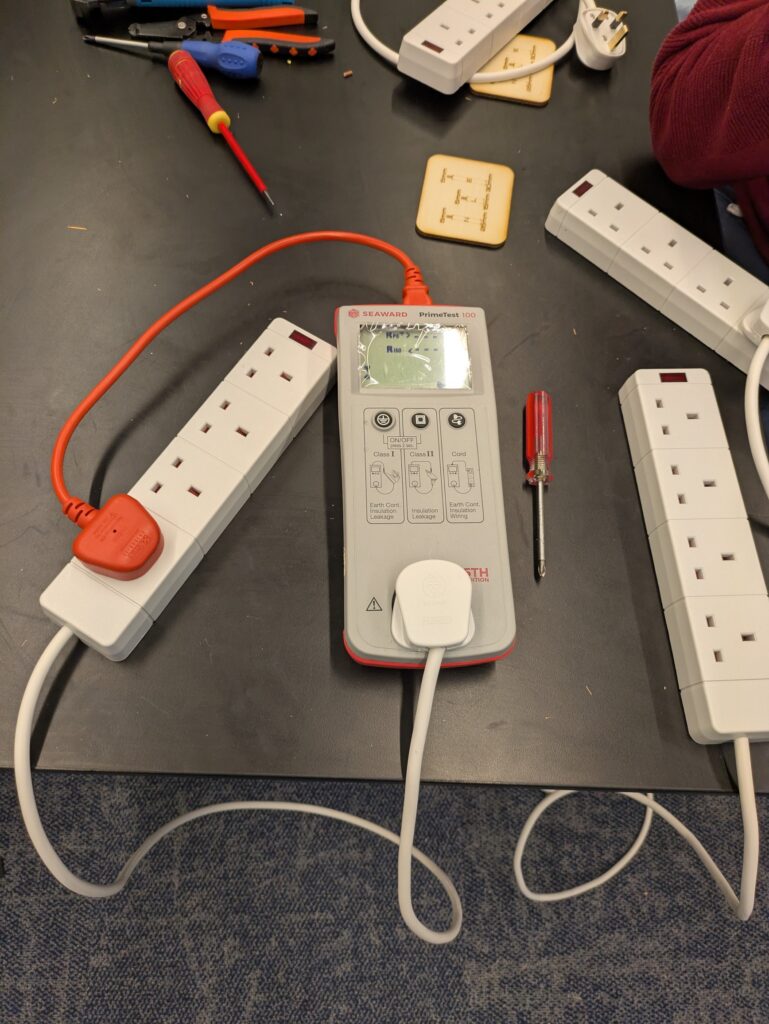
Get their finished lead PAT tested so it’s safe and ready to use at home
Take home a working, tested extension lead they built themselves
All tools and materials are provided.
Note: This workshop is wiring a portable extension lead for personal use and does not fall under Restricted Electrical Works (as per Safe Electric guidance).
Places are limited to keep it properly hands-on — so booking ahead is recommended.
Why Engineers Week?
Engineers Week is all about celebrating engineering in everyday life — and honestly, safe, practical household skills are a brilliant gateway into understanding how things work. You’ll leave with something useful, and a bit more confidence the next time you’re faced with a simple electrical fix.
Workshop details recap
📅 Date: Tuesday, 3rd March ⏰ Time:7:00 pm – 8:30 pm 📍 Location: TOG Hackerspace (see tog.ie for directions) 💶 Cost:€25 + fee (includes all materials + donation to TOG) ✅ Beginner-friendly — no experience needed
We’ve some good news to share: TOG Hackerspace is now a member of the VULCA Network, a European network of makers, makerspaces and maker networks getting involved at the European level.
VULCA’s story is very “makerspace”. They started as a bunch of friends travelling around Europe, visiting spaces, sleeping on fab managers’ and hackers’ couches, and building friendships the old-fashioned way by showing up and sharing what they knew. Over time that grew into a wider network, with a goal of helping makerspaces build connections across Europe and beyond.
We joined as a makerspace member, and we did it the straightforward way: we applied in December 2025. (VULCA open membership applications twice a year, in December and June.)
So what does this mean for TOG? In practical terms it connects us into a wider European community for exchanges, collaboration and shared learning. VULCA also supports members around mobility and cross-border collaboration, and runs meetups like the annual VULCA Seminar, a multi-day gathering for members to meet, swap know-how and strengthen the wider maker movement.
We’ll share more as we figure out what we want our first “VULCA chapter” to look like, but the aim is simple: more opportunities for TOG members to connect with other community-run spaces, learn new tricks, and bring that energy back to Kylemore Road.
We are delighted to announce that TouchDesigner Monthly Meetup series in collaboration with TOG Hackerspace will continue heading into 2026. Thanks to the support of Derivative, we will be able to sustain the series for the next six months. In addition to this, we have decided to create a name for our small collective of organisers and practitioners called NóidLab. Please give us a follow, as we aim to promote details about upcoming events and plan on sharing some of the BTS behind the meetups.
We plan on re-using the same structure as last year, as we want to keep the project sustainable and accessible for everyone involved. Each session runs for around three hours in a relaxed, hands-on setting. With multiple rooms available at TOG Hackerspace, we can host beginner and advanced activities simultaneously, ensuring everyone gets the most out of the evening. The first two hours will focus on learning, with a combination of scheduled short and long presentations/demonstrations. The last hour will take a more flattened and open approach, allowing the space for people to chat, share, learn, and explore TouchDesigner. Expect an informal, community-driven environment where the format adapts to participants. So if you would like to bring your laptop and learn the basics, share your projects, or connect with other using the software, this meetup offers a welcoming and supportive space to do so.
The event is also a great opportunity to meet other creative technologists and artists, and to continue building the growing TouchDesigner community in Ireland.
We’ve also set up a Discord server for ongoing discussion and planning. Join us there, or contact us @ noidlab.collective@gmail.com to share ideas for future sessions or to express interest in presenting your work: https://discord.gg/6s3WMdH2
A special thanks to TOG for allowing us to use the space for these events, and Derivative for supporting the project. The meetups are hosted each month by a group of artists and creative technologists:
Workshops:
For the first set of demonstrations will be run by two of our orgainsers—Ciaran & Serdar.
Ciaran will focus on utilising POPs to manipulate 3D models created with 2D images. Following this, Serdar will be demonstrating how to build a digital instrument using TouchDesigner and MediaPipe.
Today’s repair is on one of my radios – a Yaesu FT-857. While testing a new headset and tuning around the bands, the select knob twisted its last and came out of the front panel and into my hand: disaster!
This encoder is vital to using the radio, so its breaking rendered it a paperweight. The radio itself has been out of production for a number of years now, but unlike most “consumer” devices, amateur radios have very good technical documentation available to end users.
I dug up a PDF copy of the technical supplement, which contains a complete readout of the internals, block and circuit diagrams and servicing information. Reviewing the parts layout showed the front panel PCB and revealed the encoder pinout .
Searching for the Yaesu part number returned a number of retailers offering the part for 30 EUR a piece, and further digging revealed that the original part is an ALPS EC12E24244A4, which is appears to be out of production, but thankfully not an issue.
Breaking down the encoder specification – the replacement part needs to be:
Horizontal Mount
24 Detents, 24 Pulses per revolution
30mm shaft
with a push momentary switch.
Mouser to the rescue! A Bourns PEC12R-4230F-S0024 meets these requirements, and comparing it on the data sheet with the layout shows that it is a drop-in replacement.
I ordered 25 to make the shipping worthwhile, but the satisfaction of paying about a euro for a replacement part made up for it and ensured that I have a good supply for when I break it again!
I zeroed in on the exploded parts diagram and planned the repair; only a few screws were in the way.
After removing it, you can see the remains of the shaft inside the encoder body.
Unfortunately, I did not take any further photos after this point – I was in a rush to make and test the repair. Thankfully, it worked without a hitch, and I’m now back on air at home.
We’re starting something new at TOG: a bi-weekly Monday Watch Night, where we watch an episode of Tim Hunkin’s The Secret Life of Components together on the big screen, then have a relaxed Q&A and discussion afterwards.
If you’ve ever been halfway through a build and realised the “small” parts are the ones that make or break a project (literally), this series is for you. Tim has a knack for explaining why components and mechanisms are designed the way they are, what typically goes wrong in real life, and how to make better choices when you’re designing, prototyping, or repairing.
What is it?
The Secret Life of Components is a set of practical, entertaining guides for designers and makers. It covers everything from everyday essentials (switches, connectors, LEDs) to the stuff you only think about once it fails (bearings, springs, linkages, motors, relays, pneumatics, and more). It’s full of the kind of knowledge you usually pick up through years of tinkering, fixing, and building.
How the night works
Each session is simple:
Watch together (one episode per night)
Q&A and chat after: questions, examples, tangents, “how would we do this at TOG?”, and whatever the room gets curious about
And importantly:
If you miss a week, no stress. Watch the episode at home and just come along to the next one. It’s meant to be easy to drop in and out of.
Who is it for?
Open to anyone who’s curious:
beginners who want a friendly way into “why things work”
makers building projects at home
repair folks who want more background on failure modes and design choices
engineers/designers who enjoy seeing the practical side of components (and the odd bit of Tim’s humour along the way)
You don’t need any prior knowledge. If you can ask “why did that happen?” you’re already qualified.
First session
Monday 26 January
Free and open to all
TOG Hackerspace (Dublin 12, D12 CF6V)
We’ll kick off at the beginning with Episode 1: Chain, and take it from there.
Bring yourself, your curiosity, and your best questions. If you’ve a project that’s currently failing in a way that feels relevant… you’ll be in good company.
We’re delighted to share some great news from TOG. We’ve been awarded funding from As Darragh Did, a brilliant Irish charity that supports community groups, clubs, and voluntary organisations to increase participation, promote social inclusion, and build stronger communities.
This funding will allow us to expand the creative tools available in the space and kick off a new programme of inclusive, hands-on workshops focused on design, creativity, and making. Over the coming months, you’ll start to see new activities appearing at TOG that are designed to lower the barrier to getting involved, welcome new faces into the space, and give people fun, accessible ways to learn new skills.
About As Darragh Did
As Darragh Did was set up in memory of Darragh O’Shea and works to support community welfare and development across Ireland. Their funding helps local clubs, societies, and community projects to grow participation, encourage inclusion, and create positive opportunities for people to connect.
We’re really proud to be supported by them and to be part of a wider group of organisations doing grassroots community work around the country.
Thanks to this funding, we’ll be bringing new equipment into the hackerspace and using it to run a series of creative workshops and community projects. The focus will be on:
Easy, low-barrier activities for people who’ve never tried making before
Creative workshops that mix design, craft, and technology
Projects that bring people together and encourage collaboration
Activities that make the space even more welcoming and inclusive
We’ll share more soon about the specific workshops, open sessions, and ways to get involved.
Stay tuned
This funding will directly support new events and opportunities at TOG, and we can’t wait to start rolling them out. Keep an eye on the blog and our social media for announcements over the coming weeks.
A big thank you again to As Darragh Did for their support, and to everyone in the TOG community who keeps the space active, open, and full of ideas.