We’re delighted to say that TOG Hackerspace has a new 3D printer in the space.
The printer was kindly donated to us by supporters who would prefer to stay anonymous, and we want to say a sincere thank you for the gift. Donations like this make a real difference in a community space like TOG, giving members more tools to learn with, experiment with, and build exciting projects.
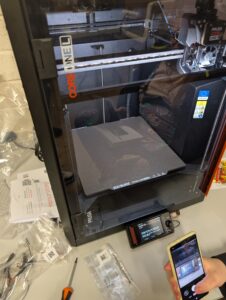
Our latest addition is a Prusa Core One L, a large enclosed printer with a generous build area, and it’s already up and running. After a bit of unboxing, setup, first prints, and making some very important “do not scrape the bed” signs, it has quickly become a great new tool for members to try out.
For anyone into making, fixing, prototyping, or learning something new, this gives us even more room to experiment. Whether you want to print a replacement part, make an enclosure for an electronics project, or finally try out an idea that has been sitting on your laptop for ages, now is a great time to jump in.
3D printing in TOG is very much a community thing. Some members are happy designing parts from scratch, others are just getting started, and there is usually someone around to help you get from “I have an idea” to “look, it actually printed”.
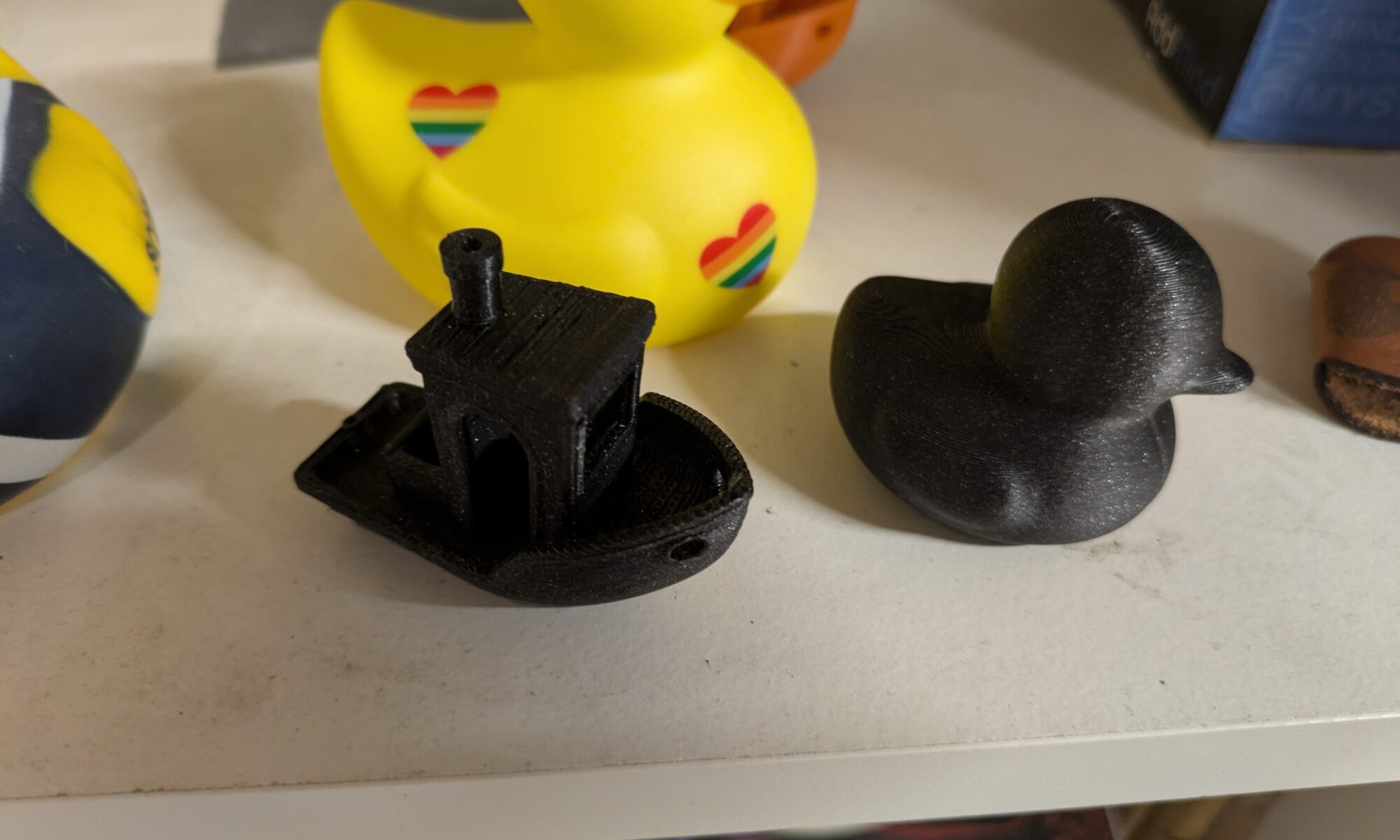
And yes, before anyone asks, printing a duck was always going to happen. It would be a bit odd for TOG to get a new printer and not make at least one duck with it.
If you’d like to give it a go, come along to our Maker Night every second Monday at 7pm. It’s a good chance to meet people, ask questions, get help with your first print, and see what else is being made around the space.
We’re looking forward to seeing what people create with it.
When you think of fairgrounds or arcades, you often picture the classic “hammer strength” game – swing a mallet, ring the bell, prove your power. For Dublin Maker this year, I wanted to flip that idea on its head – literally. Instead of smashing something down, players pull upwards against a resistance. That’s how the Reverse Hammer Machine was born.
It’s part carnival attraction, part engineering challenge, and part community experiment in building something a little quirky, a little geeky, and a lot of fun.
The Concept
The idea was simple:
Replace the hammer strike with a pulling action.
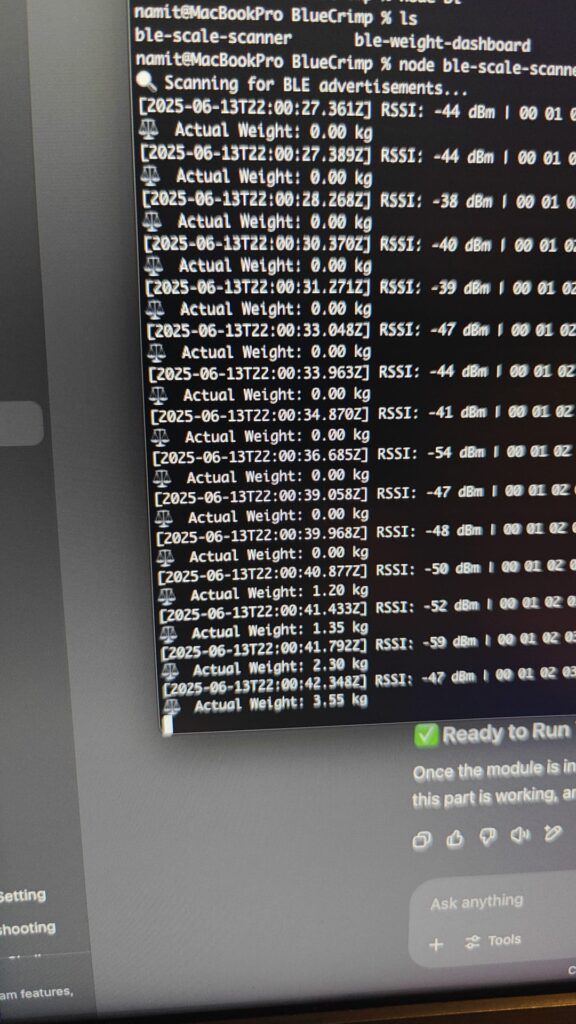
Use a Bluetooth-enabled crane scale to measure how much weight someone can pull.
Display the results on a big screen so everyone around can see the outcome.
Rather than brute force through a mallet, the machine measures grip and pull strength. It’s surprising how competitive people get once the numbers are up in lights!
How It Works
The machine looks like a cross between a fairground attraction and a maker project gone wild. Here’s what’s inside:
Bluetooth Crane Scales – these are normally used in warehouses or for weighing heavy loads. I hacked one into the system to register the pull force. Aliexpress special
ESP32 Controller – a small but mighty microcontroller that handles the Bluetooth connection, reads the data, and passes it on.
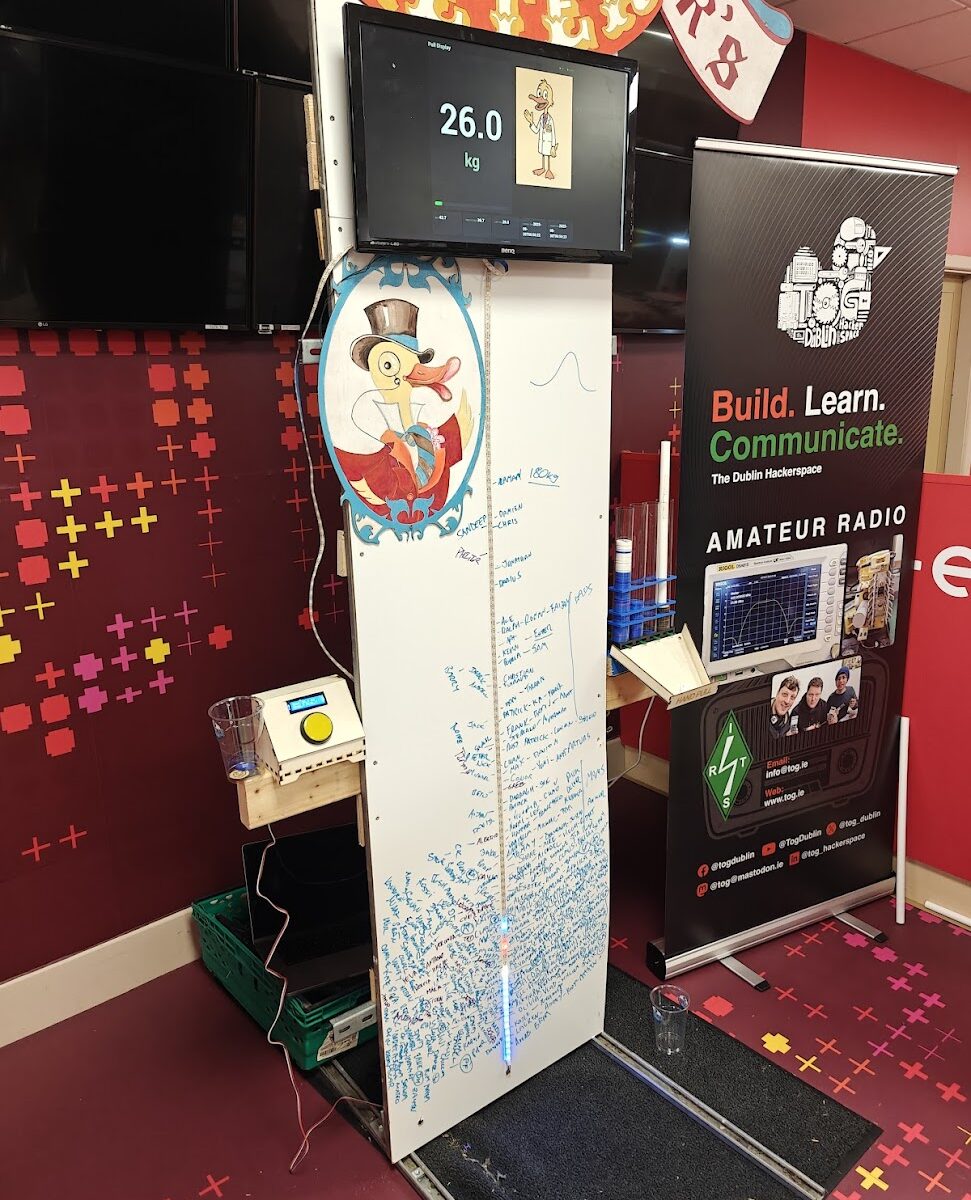
LED Strip – mounted along the board to give a visual indicator of how much force is being applied. The harder you pull, the higher the light climbs.
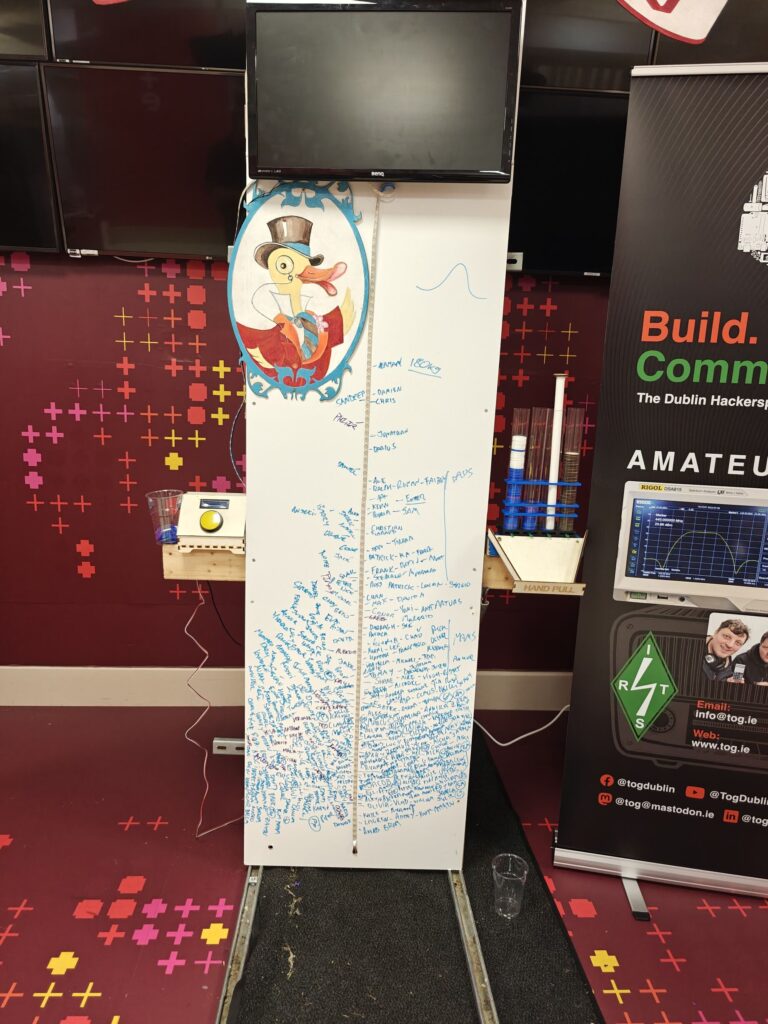
Display Screen – the live weight reading is shown on a large monitor, complete with a fun duck mascot illustration for a playful touch.
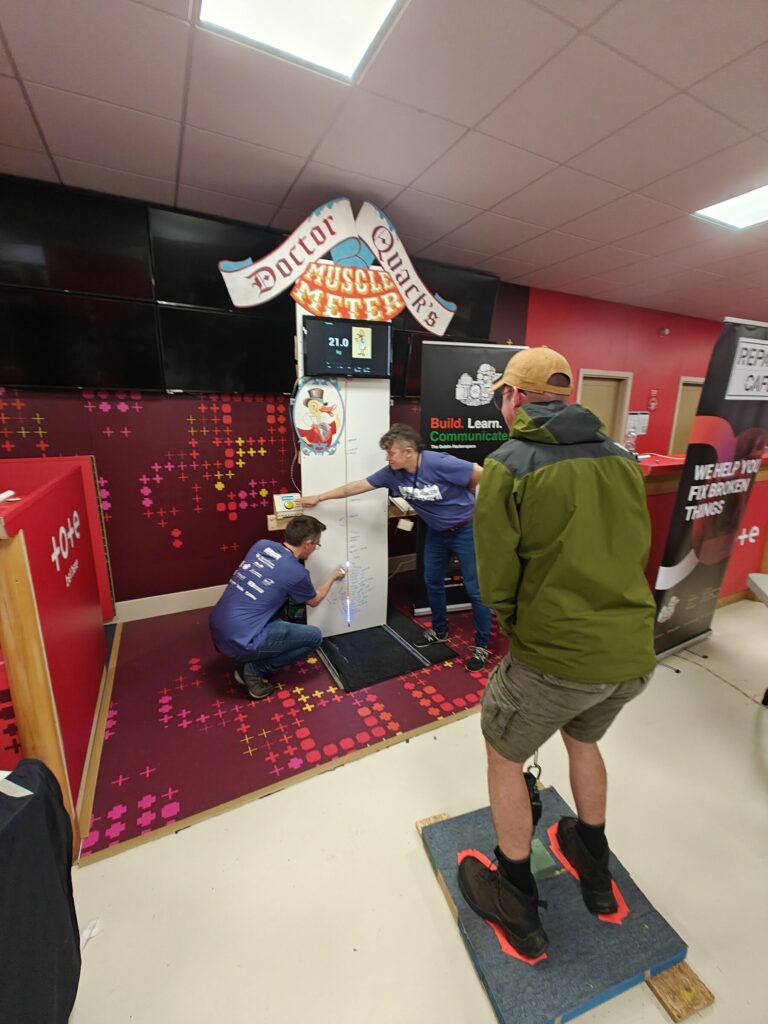
Players grab the rope, pull upwards, and watch their strength measured in real time. The numbers shoot up on screen while the LED strip glows higher and brighter – instant feedback, instant bragging rights.
The Build
I built the frame tall and sturdy, with enough presence to attract attention across the room. The whiteboard-style front not only holds the LED strip but also doubles as a canvas for signatures and doodles from players.
For more photos of the build, check out our gallery.
oplus_3145730
Some key features of the build:
Mechanical setup: The rope feeds through a pulley at the top so players can get a good pulling grip.
Electronics box: A control panel with a button and a microcontroller sits neatly to the side.
Data display: The Bluetooth scale readings are processed by custom code and displayed on the big screen with graphics.
The artwork – a cheerful duck in a top hat – was added to keep things light-hearted and tie in with the playful Dublin Maker spirit.
On Show at Dublin Maker
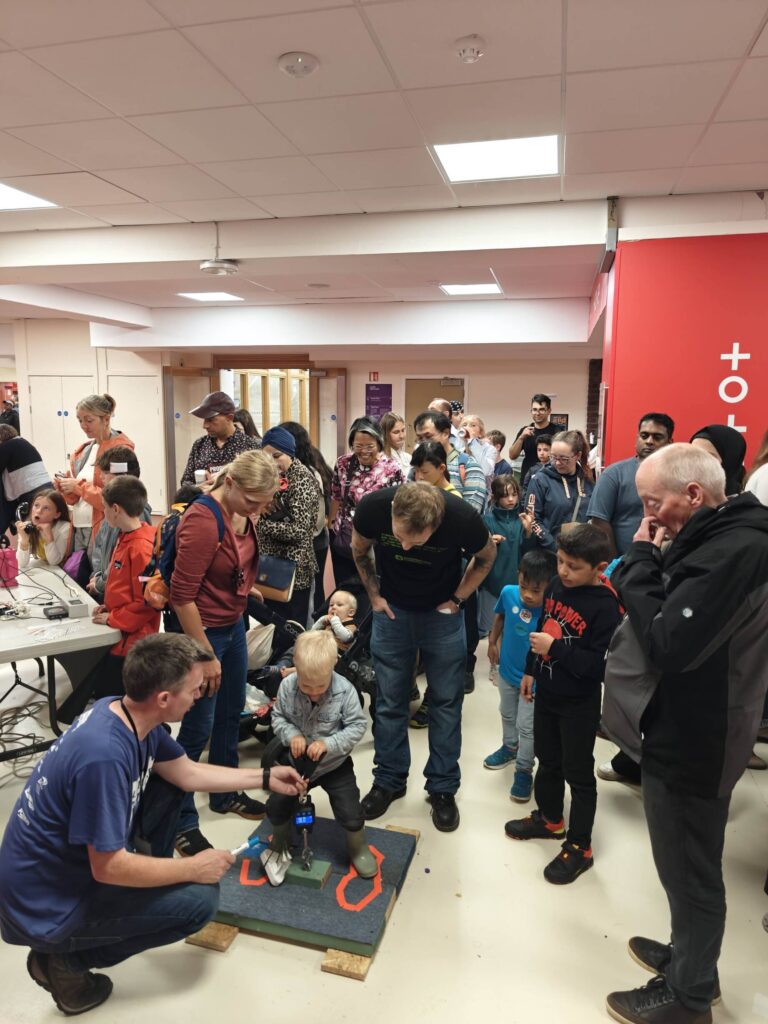
The Reverse Hammer Machine made its public debut at Dublin Maker, where visitors of all ages lined up to test their pulling power.
oplus_11534368
Lessons Learned
As with any maker project, there were a few quirks and challenges along the way:
Bluetooth quirks – the crane scale wasn’t exactly designed to be hacked, so getting stable data required persistence.
User safety – people can pull harder than expected, so making sure the frame was strong enough was a priority.
Showmanship – it’s not just about the electronics, it’s about making it fun and inviting to play and the competition of competing against family and friends.
By the end of the day, the board was covered in names, the LED strip had seen plenty of action, and the duck mascot had overseen countless strength contests.
Why Build It?
The whole point of Dublin Maker is to share creativity, curiosity, and the joy of making. The Reverse Hammer Machine isn’t just about strength – it’s about turning an idea into something physical that makes people smile.
It blends hardware hacking, coding, design, and a touch of carnival silliness into one interactive exhibit. Best of all, it gets people talking, laughing, and competing in the spirit of fun.
oplus_11534368
What’s Next?
I’d love to refine the project further:
Add a leaderboard system that stores top scores during the day.
Integrate sound effects for dramatic impact when someone hits a new record.
Maybe even design multiple “difficulty modes” with adjustable resistance.
The great thing about projects like this is they never really finish – there’s always another upgrade waiting to happen.
Bringing It All Together
The Reverse Hammer Machine shows what can happen when you take a familiar idea and twist it. By hacking together a Bluetooth crane scale, some microcontrollers, and a splash of creativity, you end up with something that feels both retro and futuristic.
It’s a reminder that engineering doesn’t have to be serious – sometimes the best projects are the ones that make people grin.
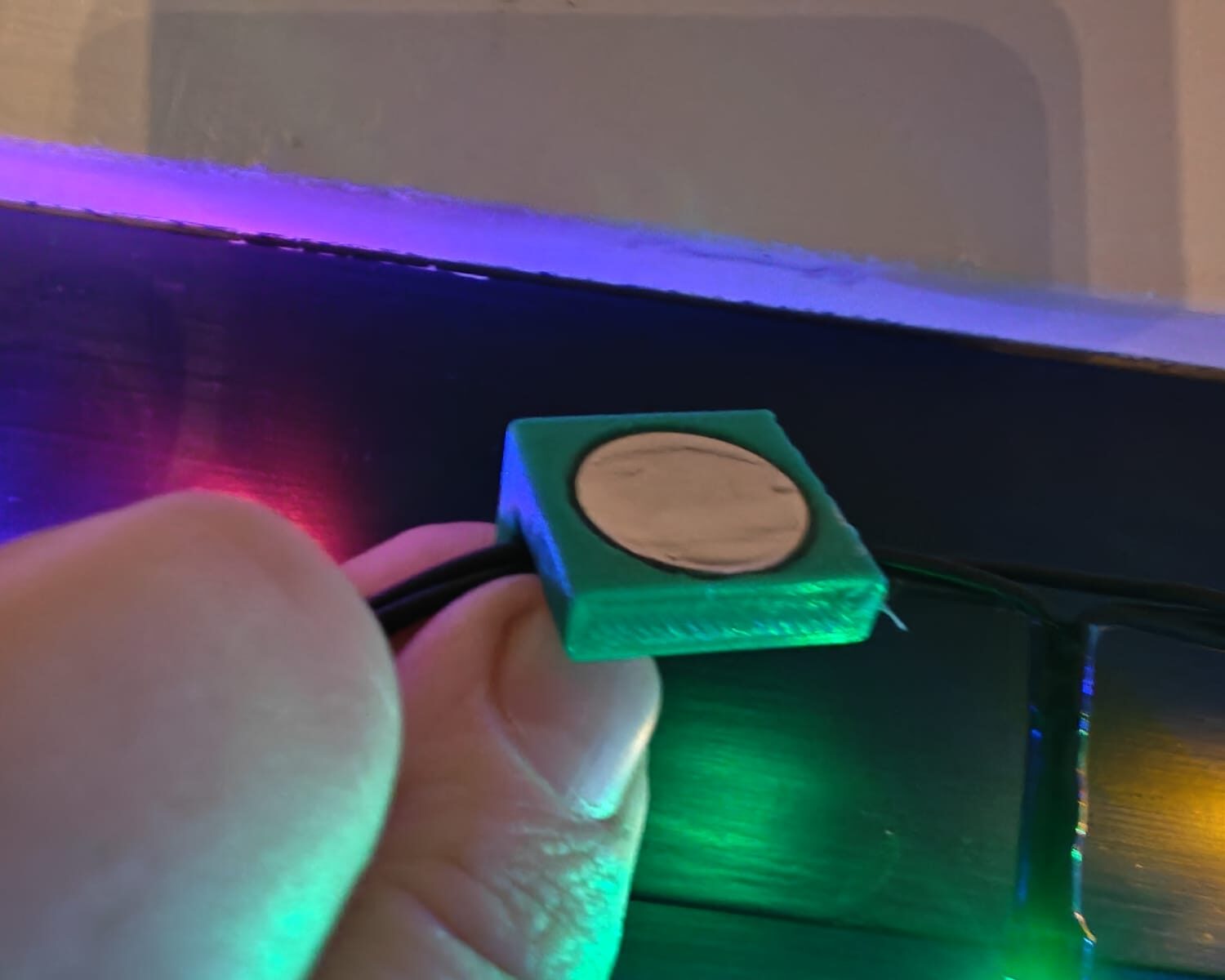
At Tog Hackerspace, we’re always exploring creative solutions to everyday challenges—and the festive season is no exception! One of our members has been busy 3D printing custom clips and holders to help keep Christmas lights neatly in place. From clever designs that attach to gutters to magnetic holders perfect for metal surfaces, these 3D-printed tools make decorating easier and more secure.
We’ve captured these innovative designs in a photo gallery to inspire your own holiday projects. Whether you’re a maker looking to create your own clips or just curious to see what can be done with a 3D printer, take a look at our gallery of 3D-printed Christmas light holders.
Feeling inspired? Join us for one of our open nights to explore 3D printing and share ideas with the Tog community!
You might have seen the LED in person in the past year at a few of our events. If you are interested in the R&D process of making project check out Robert’s youtube channel Part Fusion.
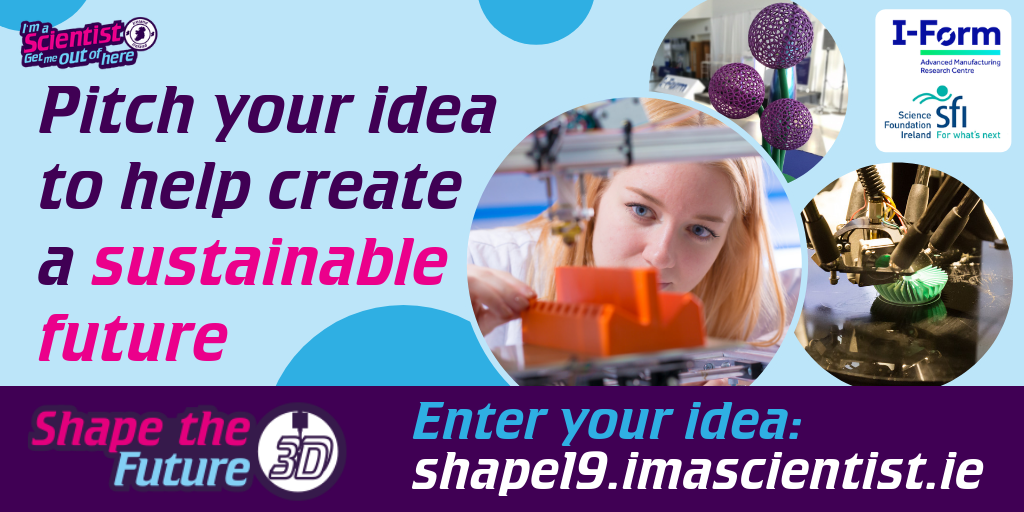
Pitch your idea and I-Form, the SFI Research Centre for Advanced Manufacturing, will turn the winning idea for sustainability into 3D printed reality.
Shape the Future is a competition open to all who have an idea to help build a sustainable future. The competition is looking for makers to show how 3D printing can help the planet. Whether it’s an idea for a new product, a new use for an old product, or simply replacing a missing a part to an engine, vintage car or old piece of kit. How can 3D printing help us reduce waste, and find new uses for old materials?
Come join us for a fun and illuminating workshop of light art with polarisation to celebrate the UN International Day of Light (IDL). IDL is an annual event to educate and promote the area of optics and photonics.
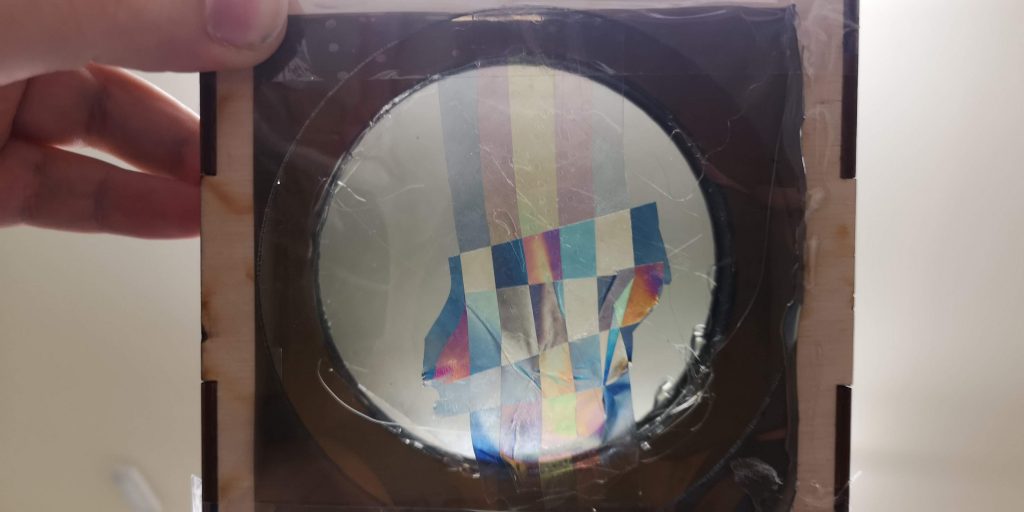
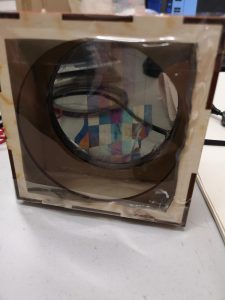
This workshop will kick off with a short presentation on polarisation and why it’s important and afterwards there will be a hands-on demonstration that will combine optics (light) and the use of fabrication techniques. Each participant will assemble a laser cut holder with 3D printed parts and then will design their own polarisation artwork. Each kit can be taken home.
This workshop is kindly supported by SPIE, the international society for optics and photonics. The workshop content is derived from the phablabs project.