OK, so not quite as old as that 1970s tape recorder that we fixed last week, but a 1996-vintage Philips AZ8640 Radio-Tape-CD boombox. The CD had stopped working, but the tape and radio were still fine.
Opening up, these things are not meant to be easily disassembled. They tend to be built from the inside out, with not much thought about future disassembly or serviceability.
When we fix old electronics, there are a few “usual suspects”, which quite often give us a fix. Old electrolytic caps are one…. they dry out after a decade or two of service. Another is bad connections or solder joints.
Solder joints, cracked or so-called “dry”, can be hard to see sometimes. Wiggling the component legs can help you see them, or simply re-touching all joints with fresh solder can do the trick. This one was quite spectacular, however.
A 3-legged power transistor that supplies power to the CD mechanism, looks like it had moved on its heat sink, and the 3 solder joints had completely detached from the PCB. Re-soldering the 3 joints brought the CD back to life. The transistor looks like it’s held to the heatsink by a spring clip rather than a screw. Perhaps the spring has failed. It’s very hard to see, and it’s a nightmare to remove the circuit board to check.
Interestingly, the transistor, a BD236, is still available new from Farnell at €0.72! Here’s hoping for another 30 years of service.
We got a message in the run-up to Christmas with a simple ask. Could we pull off a last-minute repair of a vintage tape recorder and save the day?
When the request came from our long-time friend Claire Downey, the person who first introduced us to Repair Cafés over ten years ago, we knew we had to give it a proper go.
The patient from a charity shop on the bench was an ITT Schaub-Lorenz SL54 Automatic, a Taiwanese-made radio cassette recorder from the mid 1970s, roughly 1974 to 1976. A proper bit of kit, and the kind of thing you do not want to see quietly written off and binned because “sure it’s old”.
Ambrose stepped up to take on the challenge.
If you have ever opened up something like this, the first suspect is nearly always the belts. Those rubber belts drive the moving parts, and after decades they tend to stretch, go shiny, or crumble into sticky bits. You open the case expecting the usual mess, then you cross your fingers that you have a belt in the right size somewhere in the spares box.
This time we got a surprise.
Instead of a belt that had perished with age, we found… a hair bobbin.
Somebody, at some point, had tried to get it going again using whatever they had to hand. Fair play for the creativity, but a hair bobbin is not going to keep the timing and tension right, so the tape speed was off and the audio came out warped.
The good news is we did have the right belt to hand. A straightforward swap, and while we had it open, it turned into a lovely teaching moment. That is a big part of what we do at TOG. It is not only about fixing the thing; it is about sharing repair skills and helping the owner understand what is going on inside their device.
Half an hour later, with the belt fitted and everything buttoned back up, it was time for the real test.
Out came a vintage Beatles mixtape. We hit play. Clean sound through the little speaker. Job done.
Another repair complete, another device saved from landfill, and Christmas officially rescued.
If something breaks over the Christmas stretch, or you unwrap a “project” by accident, do not panic. Bring it along to our next Repair Café on Sunday, 18 January 2026.
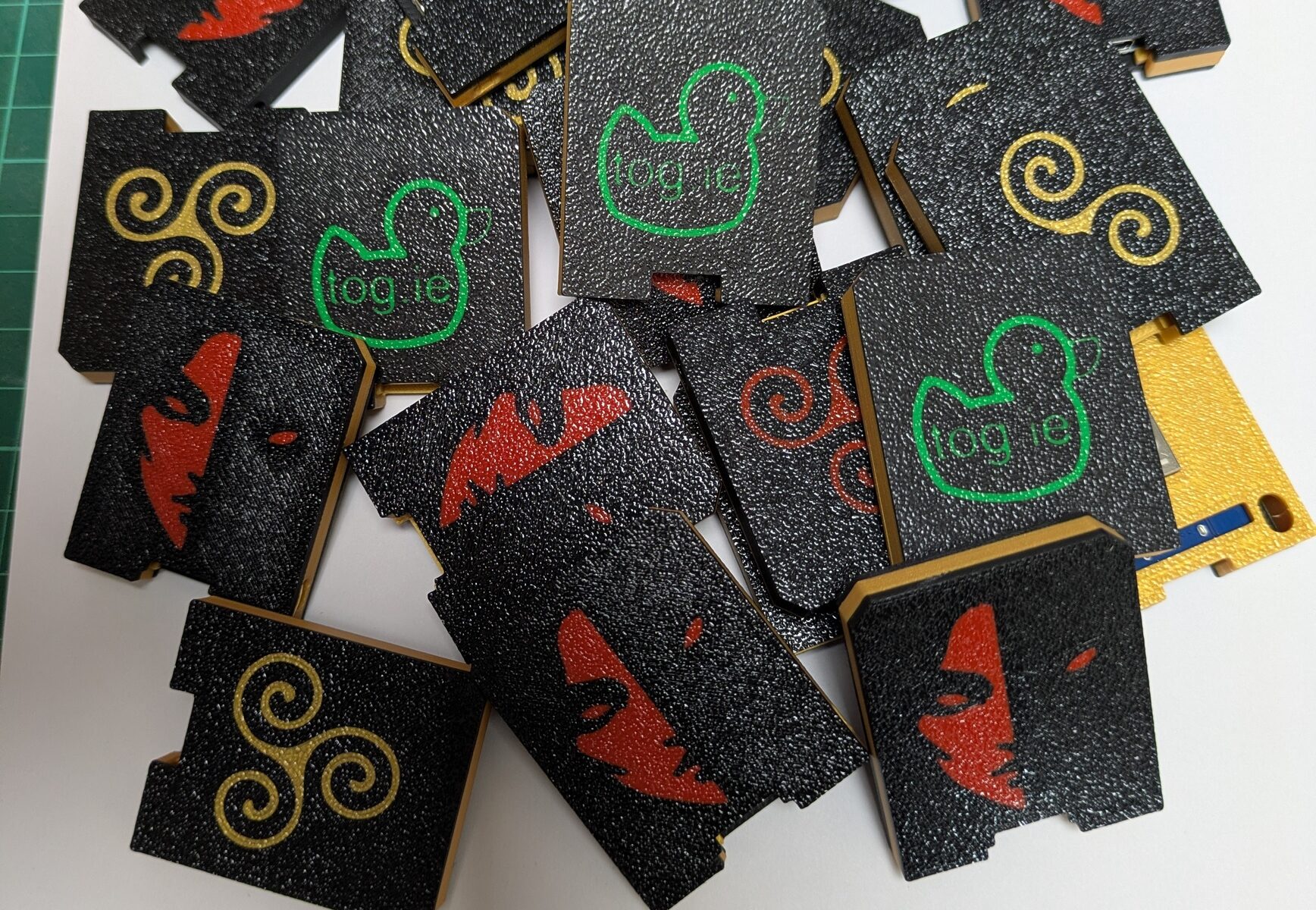
Over the last month in Tog Hackerspace, we’ve been in full festive production mode. Between design chats, test cuts, cutting sessions, and the inevitable packing table chaos, we’ve put together around 80 Christmas decorations and cards, and got them into the post as a small thank you to friends and supporters of the space.
A big thanks to Ambrose for this year’s design. It looks great, it cuts beautifully, and it gave us the perfect excuse to properly put our new laser cutter through its paces. Huge credit as well to Jeffrey for putting in serious hours on the cutting and keeping the run moving.
First big run on the new laser cutter
This was the first proper big production run on our new VEVOR 100W CO2 Laser Engraver, and it has worked brilliantly. Clean cuts, consistent results, and a far smoother process than you might expect for a first large batch. For a community workshop tool, reliability matters, and this one has already earned its keep.
Upcycled acrylic, from old shelves to Christmas decorations
One of our favourite parts of this year’s batch is the material story. The acrylic we used is upcycled. It came from a donation of bookshelves that had lived in the space for years. They did their job, but we don’t have a use for them anymore, so instead of sending the material off to waste, we turned it into something small, useful, and festive.
We also took a hint from the internet along the way. After listening to feedback, we’ve been filling up the sheets of material with more little extras to reduce waste. Of course, it’s ducks 🦆
A proper team effort
This run was a whole team effort across the month. From early design chats, to setup and test cuts, to sorting, packing, and getting everything ready for the post, loads of people chipped in. If you helped at any point, thank you. These batches only happen because the community shows up.
Even better, this event will be in aid of the Dublin Simon Community, with all proceeds going directly to those who need it this winter season.
What began as a grassroots gathering has become a festive favourite bringing together developers, designers, founders, and enthusiasts for an evening of light-hearted trivia, friendly rivalry, and charitable giving. We’re excited to keep the tradition thriving by joining us as Dogpatch Labs open up their Urban Garden for a special Christmas edition.
Dust off your cheesiest Christmas jumper, gather your sharpest teammates, and get ready for a fun, festive night of community and connection.
We have a shiny new addition to our amateur radio setup at Tog Hackerspace.
A huge thanks to Niall Donohue EI6HIB, from our friends in South Dublin Radio Club, for the generous donation of a cobweb antenna. In true Tog fashion, it has already been renamed the “TogWeb”.
Over the next few weeks we will be installing the TogWeb at the space and getting it tuned up for our HF station. The cobweb design gives us multi-band HF coverage in a compact footprint, which suits our city location nicely.
Once it is up in the air, it will:
Improve our HF receive and transmit performance
Give us more reliable contacts across Europe and beyond
Make it easier to demo HF to visitors during open nights and events
If you are interested in amateur radio, HF operation, or you are curious what all the wires and boxes are about, drop by the space on one of our open evenings. We are always happy to show people the station and talk radio.
We hope to log many more QSOs under our club callsign EI0TOG using the TogWeb. With a bit of luck, you might even end up in the log yourself.
Join us for the third in our series of monthly meetups for anyone interested in TouchDesigner, from complete beginners to experienced creators. Whether you’d like to learn the basics, share your projects, or connect with others using the software, this meetup offers a welcoming and supportive space to do so.
Each session runs for around two hours in a relaxed, hands-on setting. With multiple rooms available at Tóg Hackerspace, we can host beginner and advanced activities simultaneously, ensuring everyone gets the most out of the evening.
Expect an informal, community-driven environment where the format adapts to participants. You’re welcome to bring a laptop to follow along, showcase your work, or simply join the discussion. The event is a great opportunity to meet other creative technologists and artists, and to continue building the growing TouchDesigner community in Ireland.
Join us on our Discord to share ideas for future sessions or to express interest in presenting your work: https://discord.gg/6s3WMdH2
https://www.tog.ie
The meetups are hosted each month by a group of artists and creative technologists:
Ciaran Eaton Ciaran Eaton is a Creative Technologist and Educator based in Dublin. With a background in audio and visual arts production, Ciaran integrates visual programming environments such as TouchDesigner with open-source software and aims to foster an active community around creative workflows. Website
Serdar Buhan Serdar is a software engineer based in Dublin with a curiosity for creative technology and building interactive experiences. In his spare time, he explores tools such as TouchDesigner, Processing, Blender, AR, photogrammetry, pen plotters, and generative AI. Instagram
Cailean Finn Cailean Finn is an Irish media artist, researcher, and creative technologist from Waterford, Ireland. His practice investigates the idiosyncratic nature of human–machine relationships, drawing from computational histories and engaging with technologies and practices such as creative coding, artificial intelligence/life, game development, and physical computing. Website
Pauric Freeman Pauric Freeman is a multidisciplinary artist based in Dublin, working across audiovisual performance, sound, and installation. His practice explores translation, using data collected from live instruments as the basis for real-time audiovisual compositions. Website Instagram
Louise Nolan Louise Nolan is a multidisciplinary artist and designer working in glass, print and digital media. Her work is transmedia integrating digital techniques with physical installations to create an interactive multi-sensory experience for the viewer. She is a visiting lecturer at NCAD and TU Dublin in physical computing, creative coding and emerging media practice. LinkedIn Instagram
Gwen Stevenson Gwen Stevenson is a multidisciplinary artist exploring memory, loss, and resilience through interactive installation, experimental film, and durational performance. She uses digital technologies, motion capture, and generative systems to create immersive experiences reflecting ecological fragility and transformation. Collaboration with communities, artists, and organisations is central to her practice. Gwen is preparing for artist residencies in 2026 at the Central Academy of Fine Arts, School of Experimental Arts, Beijing, and Art Arcadia, Derry. Instagram Website